
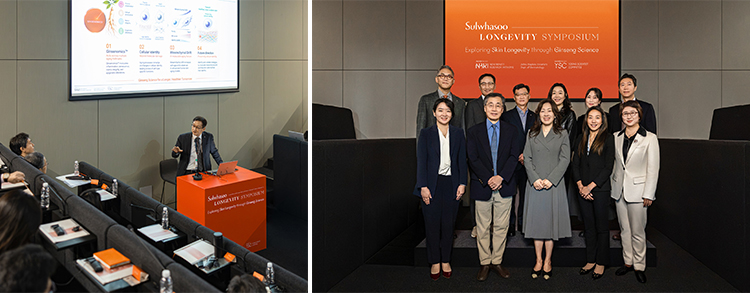
Amorepacific held the second Sulwhasoo Longevity Symposium on November 2 at its Headquarters in Seoul.
Following last year's inaugural event in New York, the United States, the second symposium brought together faculty from Johns Hopkins University School of Medicine and China, along with Amorepacific researchers, to share the latest findings on skin aging and immunity, skin structure, and cellular function.
Held under the theme "Exploring Skin Longevity through Ginseng Science," the symposium focused on cellular identity. It examined skin aging as a process in which skin cells lose their original functions and characteristics, in addition to visible changes such as wrinkles and loss of elasticity, and explored the potential to maintain and restore healthy cellular function.
In his keynote address, Professor Sewon Kang of the Department of Dermatology at Johns Hopkins University School of Medicine examined skin aging through the lens of cellular identity loss. He explored how the distinctive characteristics and functions of skin cells change with age and discussed the implications of maintaining or restoring cellular identity for skin longevity research.
Researchers from China presented a range of factors that influence skin aging, along with new research technologies. Professor Wen Xiang of West China Hospital, Sichuan University, discussed aging factors including genetic changes, cellular energy metabolism, and skin immunity, as well as research opportunities using artificial intelligence and synthetic biology. Professor Yuan Chao of Shanghai Skin Disease Hospital examined skin aging from several perspectives, including inflammatory responses and changes in skin structure, and presented an integrated approach to skin longevity based on research and clinical findings on Ginsenomics™.
The symposium also featured findings from the New Beauty Research Initiative (NBRI), an ongoing joint research program between Amorepacific and Johns Hopkins University School of Medicine. Professor Martin Alphonse discussed the relationship between Lymphanax™, Amorepacific's proprietary ingredient, and skin immunity. Building on last year's focus on immune cells, this year's research expanded to human skin tissue, examining inflammatory responses and changes in the skin's immune balance under external stress and exploring the research potential of Lymphanax™.
Professor Anna Chien presented findings from research on RE.D Flavonoid™, another of Amorepacific's proprietary ingredients. A 24-week clinical study involving 44 participants last year confirmed improvements in signs of skin aging, including fine lines, wrinkles, skin texture, radiance, and pigmentation. This year, the research expanded to the tissue and cellular levels to examine changes related to healthy skin function, including collagen, skin pigmentation and barrier function, and cellular protection.
At the symposium, Amorepacific extended its 60 years of ginseng research into the new field of cellular identity. Dr. Aiden Park of the Amorepacific R&I Center shared research outcomes examining how Ginsenomics™ affects changes related to skin cell identity under UV stress. Based on these findings, he proposed the concept of cellular identity recovery, which involves maintaining and restoring healthy cellular function, as a new direction for ginseng-based skin longevity research.
Amorepacific plans to continue investigating the mechanisms of skin aging and building scientific evidence to support the maintenance and restoration of healthy skin function, drawing on 60 years of ginseng science and global research collaborations.